

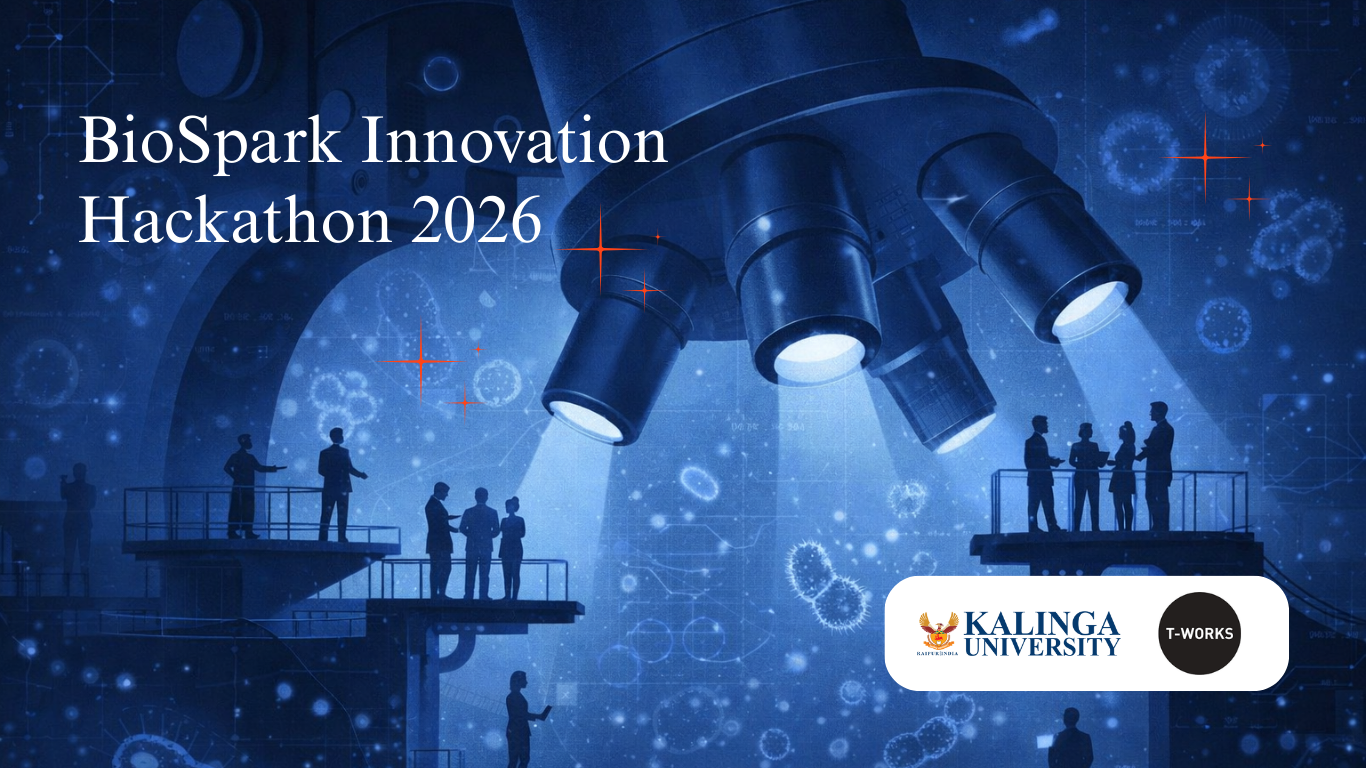
BIOSPARK INNOVATION HACKATHON
Where Nature Fuels the Next Generation of Innovation
📅 Duration
6th-20th Mar 2026 (Finals on 29th Mar 2026)
🎓 Eligibility Criteria
UG & PG students across all stream (No prior experience required)
📅 Team Size
2-4 members (Individual participation allowed)
📌 Host Locations
T-works, Hyderabad
Kalinga University, Raipur
Climate resilience and environmental engineering
Sustainable energy conversion
Food systems and regenerative agriculture
Healthcare innovation and biosystems
Biomaterials and circular manufacturing
Smart infrastructure and urban systems
Core Learning Pillars
✔ Work on future-tech problems that matter
✔ Learn bio-innovation by doing
✔ Build engineering, scientific modelling, and problem-solving skills
✔ Gain a portfolio project valued by R&D labs and innovation ecosystems
✔ Collaborate across disciplines
✔ Win certificates, awards, and recognition
Why Students Should Join
✔ Mentorship Sessions
✔ PAN India Participation
✔ Guidance by Industry experts
✔ Showcase
✔ Jury Judgement
✔ Multiple host locations
Highlights
Competition Structure
Round 1 (Elimination)
-
Focus Areas:
Problem landscape analysis
Understanding the full context of the problem — where it occurs, who is affected, and what gaps exist in current solutions.Biological analogues & inspiration mapping
Searching for natural organisms or systems that already solve similar challenges and documenting how they do it.System-level problem diagnostics
Breaking down the problem into smaller components to see how different factors interact or cause the issue.Opportunity spotting
Identifying potential areas where a new solution, approach, or biological principle could create impact.
-
Focus Area:
Bio-to-tech translation
Explaining how a biological mechanism can be converted into a usable engineering concept.Design principle extraction
Identifying the core working principle from nature that can guide the design.Functional modeling
Sketching or modelling how the solution will function from input to output.Early prototype architecture
Planning the basic structure or layout of what the prototype might look like.LO-Fi prototype development
Creating a lo-fi prototype for validating the solution and concepts.Material and component feasibility
Checking what materials, parts, or tools might be needed and whether they are practical.
-
Must Include :
Sprint Deliverables
What understanding did you earn after sprint 1 & sprint 2.Technical Problem Background
Why the problem exists and its scientific/technical context.Proposed Bio-Inspired Solution
A simple, clear explanation of the idea based on nature.Biological Mechanism Breakdown
How the chosen natural system works and why it fits the problem.Process Flow / Prototype Blueprint
A diagram showing the step-by-step functioning of the concept.Required Tools, Components & Materials
What will be needed if the prototype is built later?Sustainability & Real-World Impact Assessment
How the idea can help the environment or solve community-level challenges.
Round 2 (Eliminatio)
-
Focus Areas:
Mechanism refinement
Improving the design based on how well the biological principle is translated.Prototype detailing (POC Prototyping)
Adding clarity to structure, components, mechanics, and system performance.Validation setup & metrics
Planning how the idea would be tested and what measurements would prove it works.Risk and hazard analysis
Understanding possible failures, safety issues, or limitations.Cost modelling & scalability
Early thinking on manufacturing costs, resources, and how the idea scales.Pathway-to-implementation considerations
What steps or approvals might be needed to take this idea closer to real use?
-
Must Include :
Enhanced Design Specification
Final improved version of the solution with detailed diagrams and logic.Scientific Validation & Testing Plan
What experiments, tests, or simulations are needed to prove the design?Risk & Safety Assessment
Possible operational risks and safety considerations.Economic Viability & Cost Projection
Expected cost of materials, building, and future scaling.Regulatory / Compliance Considerations
Relevant standards, guidelines, or approvals for future deployment.Future Development & Deployment Roadmap
Short-term and long-term steps to bring the idea to real-world testing.Optional: In-Silico Simulation / Modelling
Computer-based modelling to support the concept (optional bonus).
Final Round
-
Focus Areas:
Technical storytelling
Explaining the entire concept in a clear and engaging technical narrative.Visual prototype demonstration
Using diagrams, mock-ups, or digital visuals to show the design clearly.Impact communication
Highlighting how the solution helps people, communities, or the environment.Scalability pitch
Explaining how the solution can grow, expand, or be adopted in the real world.Jury Q&A technical defence
Answering judges' questions with clarity, understanding, and confidence.
-
Important Pitch Points :
Problem Discovery: How the team identified and framed the specific problem, including context, stakeholders affected, and gaps in existing solutions
Concept Development: How biological principles were translated into an engineered concept, including options considered and final selection rationale
Prototyping Process: Lo-fi prototypes built, specific questions tested, key observations made, and design changes resulting from experimentation
Feasibility Decisions: How materials, costs, manufacturability, and practical constraints influenced design choices and trade-offs
Impact Assessment: Expected environmental, social, or technical benefits and how they guided development priorities
System Integration: How the solution fits into real-world contexts, what it replaces or enables, and adoption pathways
Next Steps: Concrete follow-on actions (POC refinement, testing, partnerships, scaling) based on learnings from the full development process
Evaluation Criteria
Judging emphasizes creativity, scientific depth, and practical feasibility.
Criterion Weight
Problem Understanding 15%
Creativity & Innovation 25%
Technical Depth & Feasibility 25%
Impact & Sustainability 20%
Documentation Quality 15%
Important Dates
Activity Mode Tentative dates
Hackathon Launch Online 7th Feb
Registration Deadline Online 5th March
Problem Statement Release Online 6th March
Round 1 Start Online 8th March
Mentorship Session Online 9th March
Round 1 Submission Deadline Online 12th March
Selection list for Round 2 Online 14th March
Round 2 Start Online 15th March
Mentorship Session Online 16th March
Round 2 Submission Deadline Online 18th March
Finalist Announcement Online 20th March
Demo & Interview Price Distribution Offline (Host Locations) 29th March
This is not just a fest—it's a launchpad for bio-driven innovation and future tech leadership.